

Honeymoon Safari Packing List 2026: Complete Glossary
TL;DR
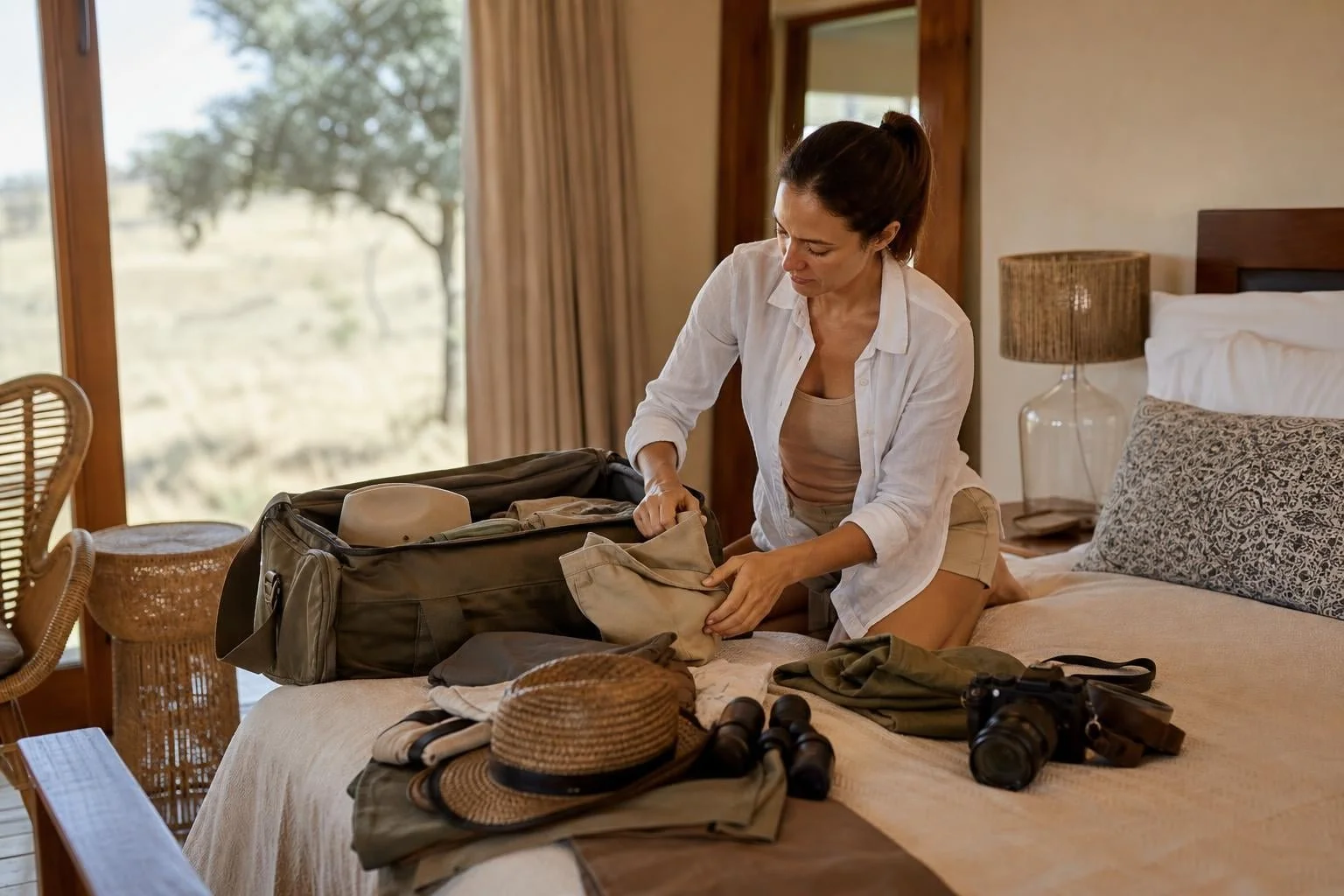
A honeymoon safari packing list covers two distinct environments (bush and beach) under strict luggage limits, typically 15 kg in a soft-sided duffel for bush flights. This glossary explains every term you’ll encounter in operator emails and packing PDFs, from earth tones and tsetse fly colors to sundowners and golden-hour outfits. Three to four safari outfits are enough because most lodges offer free laundry service.
You’ve booked the trip. Now you’re staring at a packing PDF full of terms like “soft-sided duffel,” “bush-flight weight allowance,” and “UPF-rated,” wondering what any of it actually means.
A honeymoon safari packing list is different from a standard safari checklist. Most honeymoon itineraries combine two environments, a wildlife safari in the bush followed by a beach extension on Zanzibar, which means fitting game-drive layers, lodge dinner outfits, beach gear, and celebration-worthy clothing into a single bag that meets strict airline weight limits. The typical trip runs 10 to 14 days, with 6 to 8 nights on safari and several days on the coast.
This glossary defines every term you’ll encounter while preparing for that trip so you can pack with confidence rather than anxiety. For the full item-by-item checklist with quantities, see our complete Tanzania safari packing list. This page focuses on what the terms mean and why they matter for honeymooners specifically.
If your itinerary isn’t finalized yet and you’re still deciding between a fly-in Serengeti route or a driving circuit with a Zanzibar extension, Duma Explorer can help design the trip first, because the packing list follows from the itinerary, not the other way around.
What Should You Pack for a Honeymoon Safari? A honeymoon safari packing list should prioritize lightweight, neutral-colored clothing, a soft-sided duffel, comfortable closed-toe shoes, sun and insect protection, essential medications and documents, camera gear, and a small selection of beach clothing if Zanzibar is part of the itinerary. For many Tanzania safari itineraries, internal bush flights impose strict luggage limits, so travelers should confirm the exact weight and bag-size requirements with their operator before departure. Three to four versatile safari outfits can be sufficient when laundry is available.
Honeymoon Safari Packing Terms: Quick Reference
|
Category |
Key Terms |
Why They Matter |
|---|---|---|
|
Luggage |
Soft-sided duffel, weight allowance, day pack, packing cubes |
Bush flights may have strict luggage requirements |
|
Clothing |
Earth tones, layering, UPF clothing, convertible pants |
Clothing needs to handle changing temperatures and sun exposure |
|
Insects |
Tsetse fly colors, DEET, picaridin, permethrin |
Insect protection is part of safari preparation |
|
Footwear |
Trail runners, camp shoes, reef shoes |
Safari and Zanzibar involve different terrain |
|
Health |
Malaria prophylaxis, yellow fever certificate, travel clinic |
Health requirements should be checked before departure |
|
Documents |
Passport, visa, insurance, vaccination records |
Some documents may be required for entry or travel |
|
Photography |
Beanbag, telephoto lens, mid-range zoom |
Wildlife photography requires different gear from beach photography |
|
Zanzibar |
Modest clothing, reef footwear, sunscreen, power adaptor |
Cultural and practical requirements differ from the safari portion |
|
Honeymoon |
Sundowner, bush dinner, golden-hour outfit, laundry |
These terms affect what couples may want to pack |
Honeymoon Safari Packing Checklist: What to Pack
For a typical 7- to 10-night Tanzania honeymoon safari with a Zanzibar extension, focus on lightweight, versatile items that can be worn more than once and washed at your lodge or camp. Your exact requirements depend on the itinerary, season, activities, and bush-flight operator, so confirm luggage limits before departure.
|
Category |
Recommended Quantity |
What to Pack |
|---|---|---|
|
Lightweight shirts |
4–5 |
Breathable neutral colors |
|
Long-sleeve shirts |
2–3 |
Sun and insect protection |
|
Safari trousers |
2–3 |
Lightweight, quick-drying |
|
Shorts |
1–2 |
For hot afternoons and beach use |
|
Lightweight jacket/fleece |
1 |
Cold early-morning drives |
|
Rain shell |
1 |
Packable waterproof layer |
|
Underwear |
5–7 pairs |
Adjust if you plan to hand-wash |
|
Socks |
4–6 pairs |
Lightweight, breathable |
|
Sleepwear |
1–2 sets |
Lightweight |
|
Safari shoes |
1 pair |
Trail runners or walking shoes |
|
Camp sandals |
1 pair |
Lodge and camp use |
|
Reef shoes |
1 pair |
Zanzibar and water activities |
|
Sun hat |
1 |
Wide-brim or similar |
|
Swimsuit |
1–2 |
Zanzibar/beach extension |
|
Lightweight cover-up |
1 |
Beach and cultural visits |
|
Toiletries |
1 compact kit |
Travel-size containers |
|
Sunscreen |
1–2 |
Broad-spectrum SPF 30+ |
|
Insect repellent |
1 |
DEET or picaridin |
|
Personal medications |
As required |
Keep essential medication accessible |
|
Passport/documents |
1 set |
Passport, visa documentation, insurance |
|
Power adaptor |
1 |
Confirm destination plug type |
|
Phone + charger |
1 each |
Add charging cable |
|
Camera |
Optional |
Compact setup is easier to carry |
|
Binoculars |
1 pair |
Shared pair can save weight |
|
Day pack |
1 |
Camera, water, sunscreen, layers |
|
Reusable water bottle |
1 |
Check operator/lodge arrangements |
|
Honeymoon outfit |
1–2 |
Sundowners, dinner, photographs |
The Minimal Safari Wardrobe
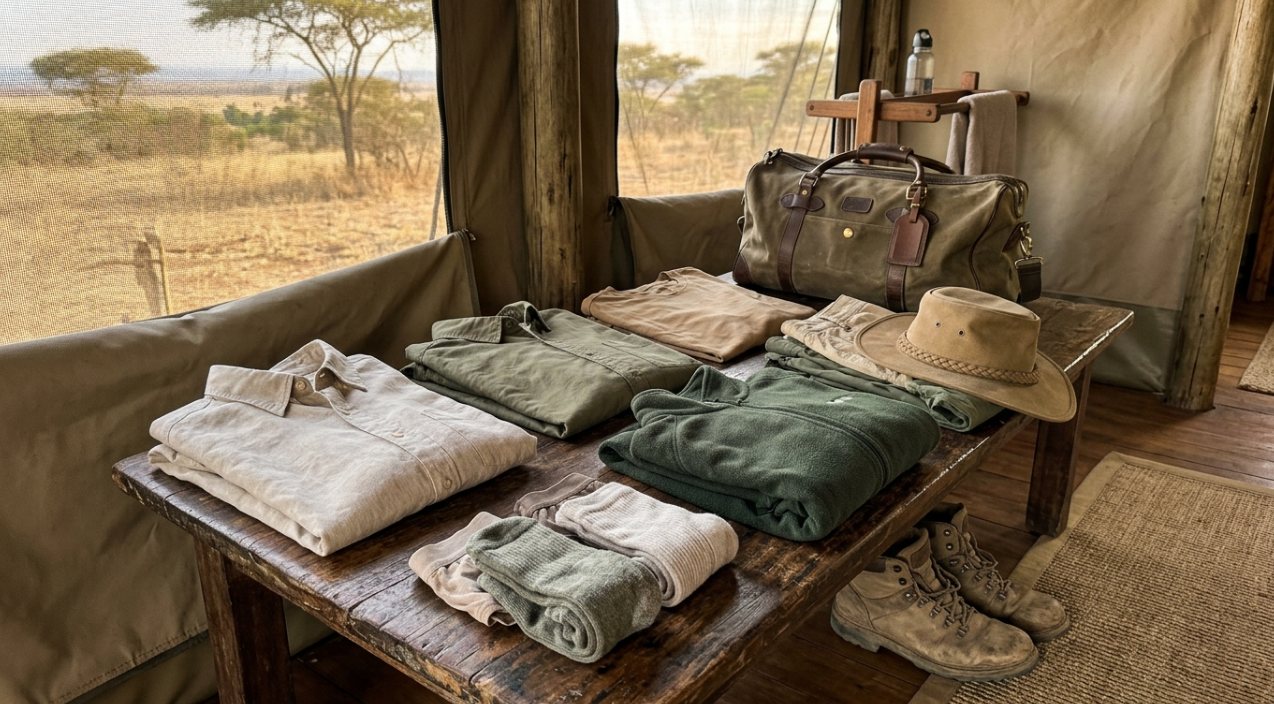
You do not need a completely different outfit for every game drive. A small rotation of lightweight shirts, trousers, layers, underwear, and socks can work well when laundry is available.
Prioritize clothing that can serve multiple purposes. For example, a lightweight long-sleeve shirt can work for a morning game drive, an evening at camp, and sun protection during the day.
Before finalizing your bag, check the luggage allowance for every internal flight on your itinerary. The most restrictive flight usually determines how much you can take.
How Much Should You Pack for a Honeymoon Safari?
The amount you need depends more on your itinerary and laundry access than on the total number of travel days. A couple spending a week on safari generally does not need seven separate safari outfits.
|
Trip Length |
Safari Clothing Approach |
Packing Strategy |
|---|---|---|
|
3–4 nights |
2–3 outfit rotations |
Minimal luggage |
|
5–7 nights |
3–4 outfit rotations |
Use laundry where available |
|
8–10 nights |
3–5 outfit rotations |
Prioritize versatile layers |
|
10+ nights |
4–5 outfit rotations |
Plan around laundry rather than adding daily outfits |
For a bush-and-beach honeymoon, separate the clothing mentally into three groups: safari essentials, lodge or dinner clothing, and Zanzibar beach/cultural clothing. Then identify items that can work in more than one setting.
The final packing quantity should be based on your actual luggage allowance, the season, planned activities, and whether laundry is available at each property.
Luggage Terms
Soft-Sided Duffel Bag
A soft-sided duffel is a flexible, frameless bag without wheels or rigid structure. Safari bush flights use small aircraft like Cessna Caravans with tiny, irregularly shaped luggage holds. A hard-shell suitcase cannot be compressed to fit these compartments, and if it doesn’t fit, it gets left behind on the tarmac. Soft duffels can be squashed and molded into whatever space is available.
For honeymooners, this means leaving your rolling suitcase at the hotel in Arusha (most operators can arrange storage) and transferring essentials into a duffel for the safari portion of your trip.
Bush-Flight Weight Allowance: Why 15 kg Is Common
A bush-flight weight allowance is the maximum luggage weight permitted on a small aircraft serving safari destinations. A 15 kg (33 lb) allowance is common on some Tanzania safari flights, but limits vary by airline, aircraft, route, and itinerary. Some operators permit more.
For this reason, do not treat 15 kg as a universal Tanzania rule. Check the exact allowance supplied by the airline or safari operator for every internal flight on your itinerary, including whether hand luggage is included in the total.
Soft-sided bags are commonly required because they are easier to fit into the limited luggage compartments of smaller aircraft. If your itinerary uses multiple internal carriers, pack according to the most restrictive applicable requirement.
Day Pack / Safari Day Bag
A small backpack (15 to 25 liters) you carry into the safari vehicle each day. It holds your camera, water bottle, sunscreen, binoculars, and a light layer. Your main duffel stays at camp. For couples, one day pack per person works best since you’ll each want your own camera gear and water accessible without digging through a shared bag.
Packing Cubes (Non-Plastic Alternatives)
Lightweight fabric organizers that compartmentalize clothing inside your duffel. They’re especially useful for honeymooners because you’re packing for two distinct environments. One cube for safari clothing, one for beach wear, one for shared toiletries. Choose fabric or mesh cubes rather than plastic zip bags because of Tanzania’s plastic bag ban.
Plastic Bag Ban (Tanzania, Since 2019)
Since June 1, 2019, Tanzania has enforced a strict ban on single-use plastic bags. This applies to bags brought into the country in carry-on and checked luggage. Ziplock bags for toiletries, plastic shopping bags, and the thin bags wrapped around shoes in your suitcase can all be confiscated at customs. Use reusable silicone bags, fabric pouches, or paper alternatives instead.
Clothing and Color Terms
What you pack depends on when you’re traveling, since dry-season and green-season safaris call for slightly different layering strategies.
Earth Tones / Safari Palette
The recommended color range for safari clothing: khaki, olive green, tan, beige, stone, and dusty grey. These colors reflect heat, hide the red dust that coats everything on game drives, blend into the bush (which matters less for vehicle-based safaris but matters for walking safaris), and, critically, do not attract biting insects.
For honeymoon photos, earth tones photograph beautifully in the golden light of early morning and late afternoon. Practitioners on travel forums consistently recommend coordinating outfits in complementary earth tones rather than matching, as it looks more natural in professional-quality images.
Dark Colors and Tsetse Flies: What Travelers Should Know
Tsetse flies are attracted to certain dark and contrasting colors, and safari operators commonly advise travelers to avoid very dark blue and black clothing in areas where tsetse flies are present. Clothing color is only one part of insect avoidance, however.
For practical packing, choose lightweight earth-tone clothing such as khaki, olive, tan, beige, or similar muted shades. Combine appropriate clothing with other insect precautions recommended for your destination, such as long sleeves, trousers, and insect repellent.
The exact insect risk varies by location and season, so follow the advice provided for your specific safari route.
Important: Leave Camouflage Clothing at Home
Travelers should avoid bringing military-style camouflage clothing to Tanzania. Rules and enforcement can vary, and camouflage patterns can create problems because they are associated with military or security use.
A simple safari wardrobe in khaki, olive, tan, beige, grey, or other muted colors provides the practical appearance most travelers want without using military-style patterns.
When in doubt, follow your safari operator's current pre-trip clothing guidance.
UPF-Rated Clothing
Clothing with a built-in ultraviolet protection factor. UPF 30+ or 50+ fabrics block most UV radiation without requiring constant sunscreen reapplication on your arms and legs. At equatorial latitudes, sun intensity is significantly stronger than most Northern Hemisphere travelers expect. A UPF-rated long-sleeve shirt is lighter and cooler than a regular cotton t-shirt with sunscreen layered underneath.
Layering System (Base, Mid, Shell)
Safari temperatures can swing 20°C in a single day. Early morning game drives start in near-freezing temperatures (especially in the Ngorongoro Crater), midday heat hits 30°C+, and evenings cool down again. The layering system handles this:
-
Base layer: A lightweight, moisture-wicking shirt worn against the skin
-
Mid layer: A fleece or softshell jacket for warmth during cold morning drives
-
Shell layer: A lightweight, packable rain jacket for unexpected showers and wind
Each layer is thin and compressible, which matters enormously when you’re working within a 15 kg limit.
Zip-Off Convertible Pants
Trousers with zip-off legs that convert into shorts. One pair functions as both long pants (for cool mornings, brushy terrain, and insect protection at dusk) and shorts (for hot afternoons at camp). They’re the single most weight-efficient clothing item for safari.
Buff / Neck Gaiter (Dust Protection)
A tubular piece of stretchy fabric worn around the neck that can be pulled up over your nose and mouth. During dry-season game drives, vehicles kick up enormous clouds of fine red dust, especially on roads in the Serengeti and Tarangire. Guests who don’t prepare for dust end up coughing or pulling their t-shirts over their noses. A neck gaiter is consistently described by experienced safari-goers as the most underrated item on any packing list. It also works as a hair band, sun shield for the back of your neck, and makeshift dust cover for camera lenses in a pinch.
What Changes on a Honeymoon Safari by Season?
Safari packing should change slightly depending on the time of year and the destinations on your itinerary. The biggest differences are usually temperature, rainfall, dust, and how much layering you need for early-morning game drives.
|
Conditions |
Packing Priorities |
|---|---|
|
Cooler mornings |
Fleece, light jacket, long trousers, closed-toe shoes |
|
Hot, dry conditions |
Breathable shirts, sun hat, UPF clothing, sunscreen |
|
Rainier periods |
Packable rain shell, quick-drying clothing, waterproof protection for electronics |
|
Dusty conditions |
Neck gaiter, sunglasses, lens protection, washable clothing |
|
Zanzibar beach extension |
Swimwear, lightweight cover-up, sandals, reef footwear where appropriate |
The same basic wardrobe can work across seasons. The difference is usually how many warm or waterproof layers you carry rather than whether you need an entirely different set of clothes.
Footwear Terms
Closed-Toe Walking Shoes / Trail Runners
Your primary safari footwear. Lightweight trail runners or hiking shoes that cover your toes, provide ankle support on uneven ground, and can handle dusty conditions. You’ll wear these on game drives (getting in and out of vehicles on rocky ground), guided nature walks, and around camp. Heavy hiking boots are overkill for vehicle-based safaris and eat into your weight allowance.
Camp Shoes (Flip-Flops or Sandals)
Lightweight sandals or flip-flops for wearing around the lodge or camp after game drives. Most lodges have gravel or stone paths between tents and the main area, so something with a sole is necessary. These double as shower shoes and casual evening footwear.
Reef Shoes (Zanzibar)
Water shoes with a protective sole, essential for the beach portion of a honeymoon safari. Many of Zanzibar’s beaches have tidal zones and coral outcrops that require foot protection, particularly for sandbank picnics and snorkeling excursions. Regular flip-flops don’t protect against coral cuts or sea urchin spines. A pair of reef shoes weighs almost nothing and saves you from spending your beach days nursing a foot wound.
Health, Documents, and Protection Terms
Travel Medicine Clinic
A specialized clinic (sometimes called a travel health clinic) that provides destination-specific vaccinations, prescriptions for malaria prophylaxis, and advice on health precautions. Book an appointment at least four to six weeks before departure to allow time for any vaccine courses that require multiple doses.
Malaria Prevention and Prophylaxis
Malaria risk varies by destination, elevation, season, and travel activities, so travelers should check current guidance for their specific Tanzania itinerary before departure.
A travel-health professional can advise whether malaria prevention medication is appropriate and, if so, which medication fits the traveler's circumstances. Common prescription options used for malaria prevention include atovaquone-proguanil, doxycycline, and mefloquine, but they are not interchangeable and have different precautions and side effects.
Do not choose or change malaria medication based solely on a packing list. Schedule destination-specific medical advice early enough to complete any recommended vaccinations, prescriptions, or preventive measures before departure.
Your travel medicine clinic will recommend the best option based on your health history. For more on malaria prevention in the region, see our malaria risks and prevention guide.
Yellow Fever Certificate
An international vaccination card (the small yellow booklet) proving you’ve received the yellow fever vaccine. Tanzania requires this certificate if you’re arriving from, or have transited through, a yellow fever endemic country. Even if it’s not required for your specific routing, some travelers get the vaccine as a precaution since it’s valid for life.
DEET / Picaridin (Insect Repellent Active Ingredients)
The two most effective active ingredients in insect repellents. DEET (at 20 to 30% concentration) has decades of proven efficacy. Picaridin is a newer alternative that’s less greasy and doesn’t damage plastics or camera coatings (relevant if you’re handling lenses).
Repellent is primarily needed during early mornings and evenings when mosquitoes are active. During the heat of the day, mosquitoes are largely dormant, and most lodges provide insect repellent in rooms and safari vehicles. Pack a small personal bottle rather than a full-sized one.
Permethrin-Treated Clothing
Clothing that has been pre-treated (or sprayed at home) with permethrin, an insecticide that kills or repels mosquitoes, ticks, and other biting insects on contact. Treating your safari pants, socks, and shirt before the trip adds a second layer of protection beyond skin-applied repellent. The treatment lasts through multiple washes.
Broad-Spectrum Sunscreen (SPF 30+)
Sunscreen that blocks both UVA and UVB rays, rated SPF 30 or higher. At equatorial latitudes, even overcast days produce intense UV exposure. Apply to any exposed skin not covered by UPF clothing. For the Zanzibar beach extension, switch to reef-safe sunscreen (see the Bush-to-Beach section below).
Tanzania Tourist E-Visa
The Tanzania tourist e-visa is an electronic travel authorization that eligible travelers can apply for through Tanzania's official immigration system. Visa eligibility, fees, processing times, passport requirements, and entry conditions can change, so verify the current requirements before departure.
Keep your passport, visa documentation, travel insurance information, flight details, and other required documents accessible rather than packing them in checked luggage.
For the latest application requirements and fees, check Tanzania's official immigration information before submitting an application. Tanzania safari visa guide.
Travel Documents to Keep Accessible
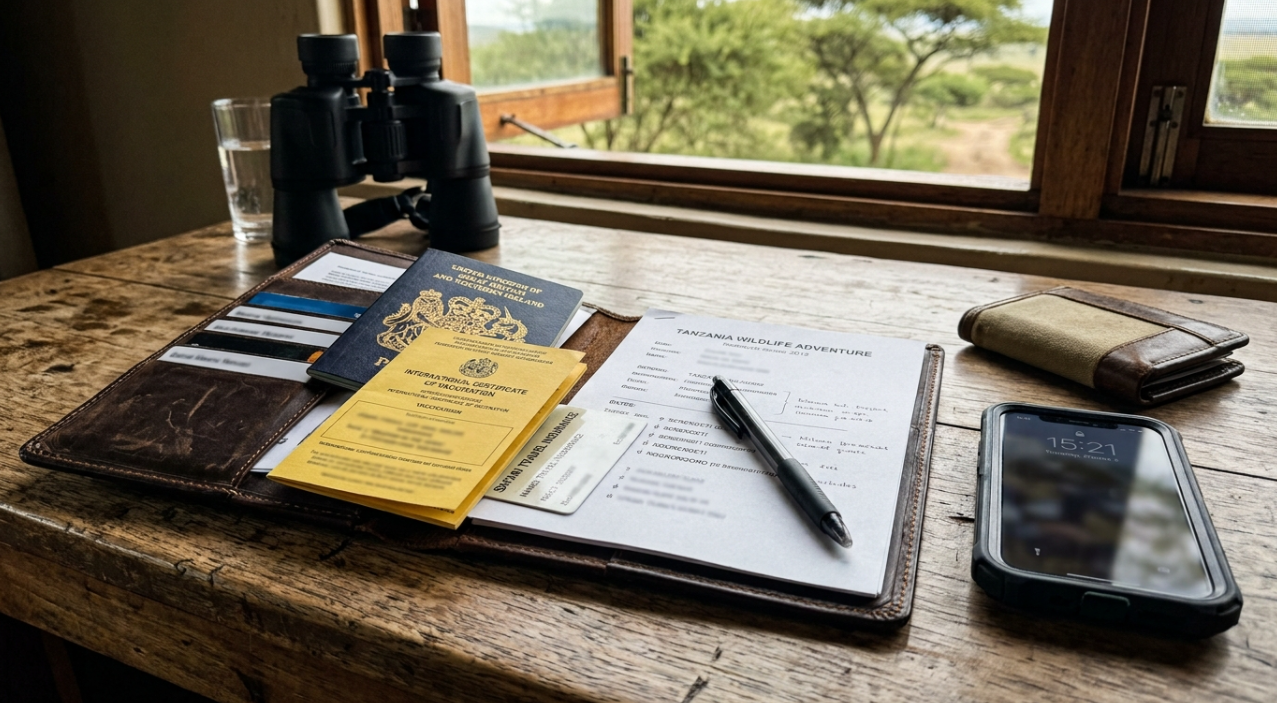
Do not treat travel documents as ordinary items inside your main luggage. Keep essential documents and digital backups accessible throughout the journey.
|
Document |
Why You May Need It |
|---|---|
|
Passport |
International identification and entry |
|
Visa/e-visa documentation |
Entry requirements where applicable |
|
Travel insurance details |
Claims and emergency assistance |
|
Flight confirmations |
Airport and domestic-flight logistics |
|
Safari itinerary |
Transfers, camps, lodges, and contacts |
|
Vaccination documentation |
Where applicable to your route |
|
Emergency contacts |
Medical, operator, and insurance assistance |
|
Copies of important documents |
Backup if an original is lost |
Keep digital copies in a secure location and carry essential originals according to the requirements of your destination and travel providers.
Travel Insurance / Medical Evacuation Cover
Travel insurance that specifically includes emergency medical evacuation. Safari destinations are remote, and getting airlifted from the Serengeti to a hospital in Nairobi or Dar es Salaam is expensive (easily $30,000+ without coverage). Standard travel insurance often excludes evacuation or caps it too low. Our safari travel insurance guide explains what evacuation cover actually means and what to look for in a policy.
Photography and Optics Terms
For a deeper guide to camera gear and terminology, see the full safari photography gear guide.
Beanbag (Vehicle Lens Support)
A small fabric bag filled with dried beans, rice, or plastic pellets that provides a stable platform for your camera lens on the edge of the safari vehicle. It’s a safari secret weapon for sharp images, far more practical than a tripod (which you can’t use from a vehicle anyway). Many experienced safari photographers on YouTube describe the beanbag as the single most important accessory for vehicle-based wildlife photography. You can buy one pre-made or sew a simple pouch at home and fill it with rice after you arrive.
Telephoto Zoom Lens (100 to 400mm)
A long-reach lens that brings distant wildlife close. A 100 to 400mm zoom is the most versatile range for safari, covering everything from a lion resting 30 meters away to a bird perched on a distant branch. One practical approach for couples: one partner handles the telephoto zoom for wildlife close-ups while the other uses a wider lens for landscapes and candid couple shots. This turns photography into a shared activity rather than a competition for the same angle, and it reduces total gear weight.
Mid-Range Zoom Lens (24 to 105mm)
A versatile lens for landscapes, vehicle-to-vehicle shots, camp scenes, and portraits. On a honeymoon safari, this is the lens that captures the romantic moments: sundowner drinks against a Serengeti sunset, candid shots of your partner watching elephants, wide views of the Ngorongoro Crater rim. Paired with the telephoto carried by your partner, you’ve covered virtually every shooting scenario.
Sensor Cleaning Kit
A small kit containing a blower, sensor swabs, and cleaning fluid for removing dust from your camera sensor. Safari environments are extraordinarily dusty. By day three, dust spots will appear in your images if you’ve changed lenses without protection. A sensor cleaning kit weighs almost nothing and saves hundreds of images.
Why Tripods Rarely Work on Safari
You are not allowed to exit your vehicle during game drives in most national parks, so a tripod has no use during the hours you’re actually photographing wildlife. The only place you’d set one up is at your lodge, and most couples won’t bother carrying a full tripod through strict weight limits for that limited use. A beanbag and a steady hand cover 95% of safari photography needs. More shooting tips in our Tanzania safari photography guide.
Bush-to-Beach Terms (Safari and Zanzibar)
Most honeymoon safaris combine two distinct environments, and this dual-environment reality is the single biggest packing challenge. For a detailed look at how to structure this kind of trip, see how a 14-day safari and Zanzibar itinerary can work.
Bush-and-Beach Combo
The standard honeymoon safari format: a wildlife safari in northern Tanzania (Serengeti, Ngorongoro, Tarangire) followed by a beach extension on Zanzibar or the Swahili Coast. Because these two environments require different wardrobes under a single luggage limit, packing requires deliberate planning. The key strategy is to identify items that work in both settings (a neutral linen shirt works at the lodge and at a beach restaurant) and minimize single-use items.
Couples planning a safari and Zanzibar honeymoon can ask Duma Explorer to build a seamless itinerary so the bush-to-beach transition, and the packing, is handled from the start.
Zanzibar Modesty Norms
Zanzibar is a Muslim-majority region where covering shoulders and knees is respectful when walking through Stone Town or visiting villages outside resort areas. This catches many honeymooners off guard, especially those arriving straight from a relaxed beach resort. A lightweight sarong or a long, breathable skirt works well and takes up almost no space in your bag. Resort pools and beaches have no dress code, but stepping outside the resort grounds calls for modest coverage.
For more on cultural expectations, see the Zanzibar culture glossary.
Reef-Safe Sunscreen
Sunscreen formulated without oxybenzone and octinoxate, chemicals that damage coral reefs. Zanzibar’s marine environment is a major draw for snorkeling and diving, and reef-safe formulas protect it. Look for mineral-based sunscreens using zinc oxide or titanium dioxide as the active ingredient. Apply the same SPF 30+ standard as on safari.
Universal Power Adaptor (Type G / UK Three-Pin)
Tanzania uses the British-style Type G plug with three rectangular pins. Most safari lodges and Zanzibar hotels have limited outlets (sometimes only one per tent or room), so a single universal adaptor with USB ports lets you charge two phones and a camera battery simultaneously. Bringing a small power strip with a Type G plug is even better for couples sharing a single outlet.
Honeymoon-Specific Terms
These are the terms that no standard safari packing list covers, and they’re the reason you searched for a honeymoon safari packing list specifically.
Sundowner
A late-afternoon drink (typically gin and tonic, wine, or a cocktail) enjoyed at a scenic viewpoint while watching the sun set. On a honeymoon safari, sundowners are often arranged as private experiences by your guide, who will find a quiet spot overlooking the plains. Pack for this moment: a light layer for the cooling evening air and, if you care about photos, a clean shirt that doesn’t have four hours of game-drive dust on it.
Private Bush Dinner
A candlelit dinner set up in a secluded location away from the main lodge, often under the stars or beside a campfire. Many romantic safari lodges include this as a complimentary honeymoon touch, while others offer it on request. The packing implication: bring at least one slightly dressed-up outfit. A nice dress or a collared linen shirt paired with clean trousers is the standard. You don’t need formal wear, but you’ll appreciate having something that isn’t your dusty game-drive clothes.
Golden-Hour Outfit
An outfit planned specifically for photography during the hour after sunrise or before sunset, when light is warm and flattering. Planning two to three outfits with photography in mind is one of the most underrated honeymoon packing strategies. A pair of safari-tan linen coordinates worn at golden hour against a Serengeti backdrop will produce photographs that look professionally styled. Coordinate with your partner on complementary tones rather than identical colors.
Celebration Touches (What to Tell Your Operator in Advance)
Small items or arrangements that mark the honeymoon as special: a bottle of champagne chilled in your tent, rose petals on the bed, a private sundowner setup, or a bush dinner. The packing tip here is actually a communication tip. Tell your operator about your honeymoon before you arrive. Most lodges will arrange romantic extras at no charge if they know in advance, but they can’t do anything if they find out at check-in.
Laundry Service (Why 3 to 4 Outfits Is Enough)
Most safari lodges and tented camps offer laundry service, often included in the nightly rate. Clothes are hand-washed and line-dried, usually returned within 24 hours. This means three to four outfits can carry you through a trip of any length. Honeymooners routinely overpack because they assume they need a fresh outfit for each day. You don’t. The laundry cycle and lightweight fabrics that dry quickly make a minimal wardrobe entirely practical.
The underwear exception: At nearly all safari camps, guests wash their own underwear. This is a cultural norm, not a hygiene rule. Pack enough underwear for 4 to 5 days and hand-wash every few nights.
Tipping Cash (Denominations, Condition, and Post-2006 Bills)
Budget approximately $20 to $40 per person per day in total tips for guides, lodge staff, and other service providers. For a seven-day safari, that’s roughly $140 to $280 per person in small US bills ($1, $5, $10, $20). Bills must be printed after 2006 and in good condition, as Tanzanian banks reject older or damaged US currency. Get crisp bills from your bank before departure. For exact amounts by role, see the detailed Tanzania safari tipping guide.
What NOT to Pack (The Anti-Glossary)
These items appear in luggage regularly and cause problems just as regularly.
|
Item |
Why It’s a Problem |
|---|---|
|
Hard-shell suitcase |
Cannot fit in bush-flight luggage holds; will be left behind |
|
Heavy denim jeans |
Too hot, too heavy, takes forever to dry, eats into your 15 kg allowance |
|
Camouflage clothing |
Illegal in Tanzania; associated with military/anti-poaching units |
|
Bright white clothing |
Shows every speck of red dust, creates harsh photo glare |
|
Strong perfume or cologne |
Attracts insects; disturbs wildlife at close range |
|
Disposable plastic bags |
Banned in Tanzania since 2019; confiscated at customs |
|
Full-size toiletries |
Weight killers; decant into small containers and share between partners |
|
Tripod |
Can’t be used from inside the vehicle; dead weight for lodge-only use |
|
Multiple pairs of shoes |
Three pairs maximum (trail runners, camp sandals, reef shoes) |
Frequently Asked Questions
How much luggage can I bring on a bush flight in Tanzania?
Most bush-flight operators allow 15 kg (33 lbs) per person, including hand luggage. Bags must be soft-sided. Coastal Aviation enforces maximum dimensions of 76 x 48 x 29 cm. Air Excel allows 20 kg per person. Your day pack counts toward this total.
Can I pack a hard suitcase for a honeymoon safari?
Not for the bush portion. Small aircraft have irregularly shaped cargo holds that cannot accommodate rigid luggage. Bring a soft-sided duffel for safari segments. If your trip starts or ends in a city like Arusha, you can store a hard suitcase at your hotel and retrieve it for the Zanzibar beach extension (where standard luggage is fine).
What colors should I avoid on safari and why?
Avoid black, dark navy blue, and very dark colors, which attract tsetse flies and mosquitoes and absorb equatorial heat. Avoid bright white, which shows dust and creates photo glare. Avoid camouflage, which is illegal in Tanzania. Stick to khaki, olive, tan, beige, stone, and dusty grey.
Do I need separate bags for the safari and Zanzibar portions?
Not necessarily. Many couples use a single soft-sided duffel for the entire trip. If your bush-to-beach transition involves a flight back through Arusha, you can swap out some safari clothing for beach items from a stored bag. If you fly directly from the bush to Zanzibar, everything needs to fit in one bag under the weight limit. Packing cubes help separate the two wardrobes within a single duffel.
Will my safari lodge do laundry?
Almost certainly. The majority of safari lodges and tented camps offer laundry service, often included in your stay. Clothes are hand-washed and line-dried within 24 hours. Underwear is the standard exception, which guests wash themselves. This makes it possible to pack just three to four safari outfits regardless of trip length.
What camera gear should a couple bring on a honeymoon safari?
A practical split: one partner carries a telephoto zoom (100 to 400mm) for wildlife, while the other carries a mid-range zoom (24 to 105mm) for landscapes and couple shots. Add a beanbag for vehicle-based stabilization, a sensor cleaning kit, extra memory cards, and spare batteries. Skip the tripod.
Is malaria medication necessary for a Tanzania safari?
The northern Tanzania safari circuit (Serengeti, Ngorongoro, Tarangire) is a malaria zone. Malaria prophylaxis is strongly recommended. Consult a travel medicine clinic at least four to six weeks before departure to choose between Malarone, doxycycline, or mefloquine based on your health profile.
How much tipping cash should we bring?
Budget $20 to $40 per person, per day for the safari portion. For a couple on a seven-day safari, that means roughly $280 to $560 total in small US bills. Bills must be post-2006 and in clean condition. Request fresh bills from your bank.
Start Planning Your Honeymoon Safari
The packing list becomes simple once the itinerary is clear. Knowing whether you’re flying into the Serengeti or driving, whether Zanzibar is three days or five, and which lodges you’ll stay at determines exactly what goes into the duffel.
Plan your Tanzania honeymoon safari with Duma Explorer, and the packing becomes the easy part.